

The Magazine
“We Are Rights Holders, Not Stakeholders!” Proclaim Indigenous People at the 25th UN Permanent Forum on Indigenous Issues
- By: Jen Deerinwater
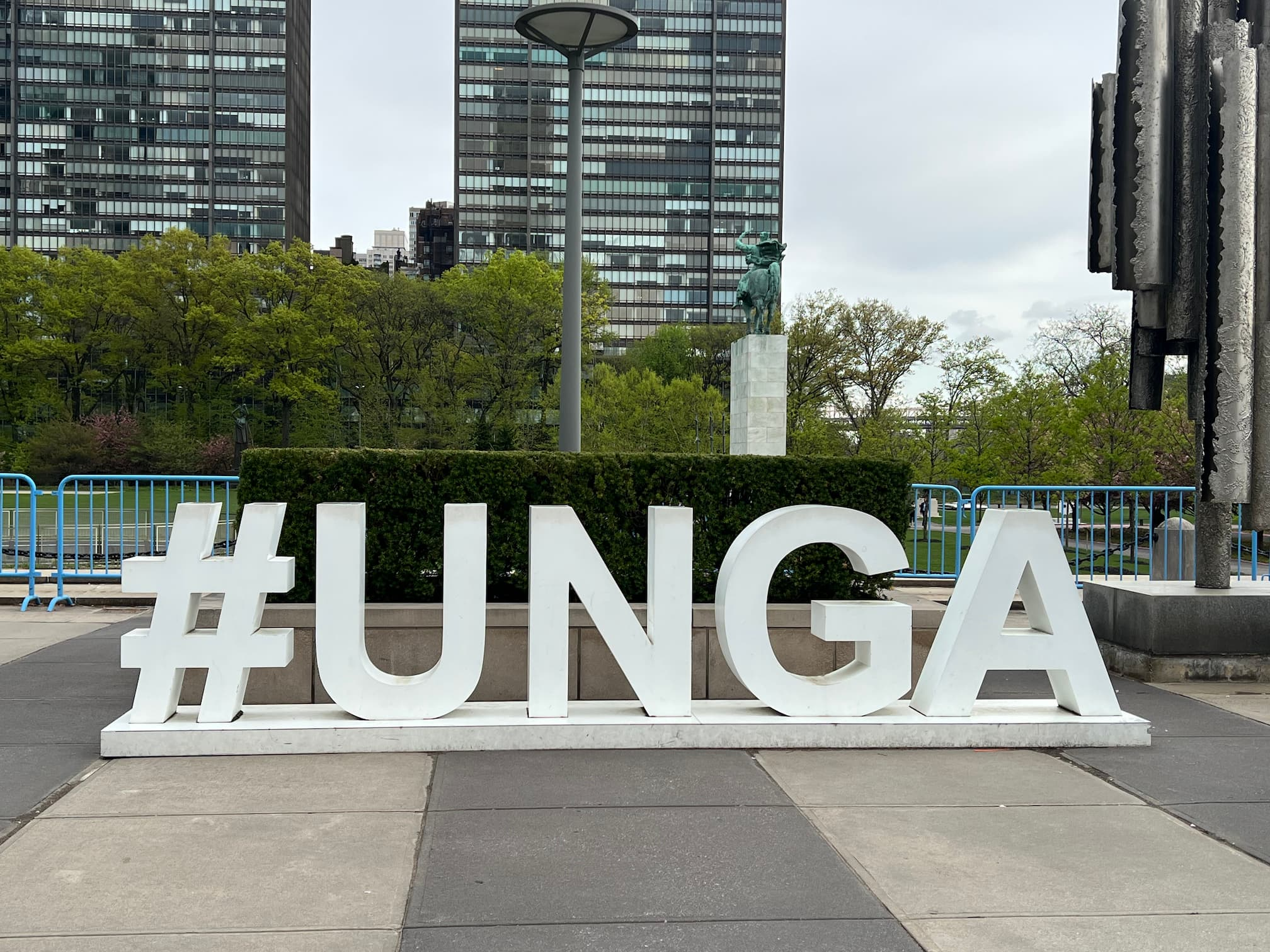
The United Nations General Assembly Hall was abuzz with conversation when a loud clacking sound began, followed shortly by singing. Katisha Star Rose Paul sang a Coast Salish Paddle Song her family wrote, while she led a line of Indigenous people into the Hall as the cultural invocation to begin the 25th Permanent Forum on Indigenous Issues.
The United Nations Permanent Forum on Indigenous Issues (UNPFII) is the only platform where Indigenous Peoples participate as rights-holders within the United Nations (UN). It was created in 2000 under the Economic and Social Council and covers issues relating to culture, health, education, human rights, and economic and social development.
The United Nations Declaration on the Rights of Indigenous Peoples (UNDRIP) affirms the rights of Indigenous Peoples to their lands, cultures, identities, self-determination, and to full and effective participation in decisions that affect them.
Over 1,000 participants were registered for the UNPFII, the theme of which was “Ensuring Indigenous Peoples’ health, including in the context of conflict.” The UN also declared 2026 the International Year of Rangelands and Pastoralists to advocate for “increased responsible investment and adapted policies for the pastoral sector.”
Indigenous Determinants of Health
Indigenous people represent approximately 6% of the world’s population, but there are large variations in the numbers of Indigenous people in the UN member states. For example, Indigenous people represent 56% of Fiji’s population, but only 3.8% of “Australia’s” population. Mobile Indigenous Peoples (MIP) live across the seven UN-recognized regions of the world, and approximately half the world is covered in rangelands.
The UN Indigenous Determinants of Health (UNIDH) was the primary focus at this year’s UNPFII. It’s relatively comprehensive in its approach to the health and well-being of many, but not all, Indigenous people. It states that Indigenous conceptions of health are “based on a state of systemic balance, reflecting the integrity of ecology, biodiversity, governance, culture, language, knowledge and intergenerational continuity.” As a result, the health of Indigenous people is directly linked to the health of the natural environment and culturally respectful access to language, culture, and self-determination. It also functions as a “cross-cutting indicator of the impacts and effectiveness of actions (or inactions) across other sectors.” Essentially, the health of Indigenous People means the health of all life.
But how can all Indigenous people have good health if they don’t have access to disability accessible housing, transportation, mobility devices, or cultural and spiritual traditions? The UN estimates that approximately 15% of the world’s population is Disabled. The Indigenous Persons with Disabilities Global Network estimates that the number of Disabled Indigenous People is 71 million. They estimate that 45 million Disabled Indigenous people live in the Asia Pacific region, in so-called developing and underdeveloped countries. Rates of disability are higher for Indigenous women and Two-Spirit, Lesbian, Gay, Bisexual, Transgender, Queer, and Intersex (2SLGBTQIA+) people. These catastrophic rates of disability and chronic illnesses are not due to genetics but rather the global impacts of colonialism, violence, and systemic oppression.
But these statistics are incomplete, as there has been no comprehensive global study of Disabled Indigenous People. Even the UN’s global population numbers for Disabled people are from 2013. This number is surely higher now due to the climate crisis, COVID-19, conflicts, and war.
Despite higher rates of disability in Indigenous communities, disability was barely mentioned at the UNPFII, nor included in the UN Indigenous Determinants of Health (UNIDH) document or talks. One of the few mentions of disability during the UNPFII was made by AC Locklear, CEO of the National Indian Health Board, when he stated that some elders require wheelchair ramps. However, this excludes the vast array of disability access needs for different types of disabilities and erases the very existence of Disabled Indigenous People who aren’t elders.
The health needs of 2SLGBTQIA+ Indigenous People were also excluded from the UNIDH, as was a full range of reproductive care, including abortion, birth control, gender-affirming care, and access to HIV/AIDS protections and care rooted in Indigenous cultural models of care.
Indigenous Health in Conflict & War Zones
The policing, militarization, and closing of nation-state borders in conflict and war zones heavily impact Indigenous People and their health. MIPs in particular suffer, as many lack formal recognition as Indigenous nations, and the criminalization of movement cuts off access to food, culture, and community that have existed since time immemorial. The MIP understands mobility and their movement as a “sacred and ceremonial act.” The routes chosen are deliberate and rooted in knowledge and ceremony since time immemorial.
In one of the many side events held by Indigenous organizations from around the world, representatives from the Crimean Tatar Resource Center stated that there are nearly 200 wars globally. Since 2014, the Indigenous Crimean Tatar people have suffered “systematic pressure and persecution” due to their opposition to Russia’s occupation of Crimea. In 2016, Russia declared the Mejlis, a representative body of the Crimean Tatars, an “extremist organisation” and banned all of their activities. In a further attempt to strip the Tatar people of their self-determination, 90% of Crimean Tatar language media closed due to Russia’s anti-Indigenous, bureaucratic censorship laws.
During the UN discussion on the six mandated areas of the Permanent Forum with reference to the UNDRIP and 2030 Agenda for Sustainable Development, representatives from The Streets Movement spoke of the violence committed against the Indigenous people of West Papua. Military curfews, murder, and internal displacement are just a few of the human rights abuses that have only worsened since Indonesia and Australia signed the Treaty on Common Security, which deeply co-mingled the two countries’ military forces and reach. This has only exasperated the colonization and genocide of Indigenous West Papuans by Indonesia under the 1969 Act of Free Choice.
Manipur, India, home to 33 Recognized Scheduled Tribes, has suffered from war since British colonial rule. Under the Armed Forces Special Powers Act, a form of martial law, created under the then newly independent India, was forced upon 45 million Indigenous people, resulting in the murders of 20,000 Indigenous People in Manipur and 50,0000 across Northeast India. Mass murders have occurred since 1958, leaving “killing fields” across the region. Violence continued over the years and exploded in 2023, resulting in 10,000 homes burned, 70,000 people displaced, over 200 people dead, and others are still missing today.
As a result of colonization and conflict, there’s a lack of proper nutrition, clean water, housing, hygienic infrastructure, and high rates of disabilities and illnesses, such as HIV/AIDS. Manipur sits within the “South Asia Golden Triangle,” an area of Asia known for drug trafficking. Manipur’s total population represents 0.2% of India’s population, but has approximately 8% of India’s total HIV-positive cases. Despite the genocide, the Indigenous people of Manipur have resisted for decades, including organizations like the All Tribal Disables Union Manipur to help meet the community health and disability needs.
Barbaric Extractivism and Indigenous Health
The health of the natural environment and the rights to self-determination, in particular over Indigenous territories, were identified as a part of the UNIDH and were widely discussed during official and side events at the UNPFII. Although Indigenous People have contributed the least to global greenhouse gas emissions, they are disproportionately and often irreversibly harmed as a result. War, capitalism, and colonialism created the climate crisis, which is furthering the genocide of Indigenous People and nations.
A 2023 global academic study found that at least 34% of Indigenous People are in documented environmental conflicts worldwide. More than three-fourths of these conflicts are caused by mining, fossil fuels, dam projects, and the agriculture, forestry, fisheries, and livestock (AFFL) sector. 50% of Indigenous land dispossession (50%) occurs under AFFL. As a result, Latin America is the most dangerous region for the defense of land, representing 82% of murder cases, with Indigenous People disproportionately facing higher rates of violence, representing 33% of murders. Colombia, which has the highest rate of biodiversity globally and recently elected a fascist president, suffers the highest rates of murders of land defenders in the world.
Environmental degradation directly impacts the UNIDH in a litany of ways. A Navajo Nation representative spoke of the mental and emotional health impacts on their nation due to the wastewater spread on their sacred mountains. This has resulted in fewer people going there for the ceremony.
Ellen Saijets of the Youth Council from the Sámi Parliament in “Finland” spoke of similar issues. Saijets shared how generations of fishing have ended at a river in Sápmi, the Sámi homelands, and it’s now too painful for some to even look at the river. She explained further that Sámi women have the burden of additional work while the reindeer herders, who are traditionally men, must be away from home longer due to the climate crisis.
Kaylena Bray (Seneca), traditional food and policy leader, made further connections between the natural environment, food, culture, and war. Bray explained that the Three Sisters crops-beans, squash, and corn-grow together as they nurture each other, the Earth, and Indigenous People and nations. The women typically oversaw the food for their tribe and also decided if the nation went to war because if there’s no food, then there’s no ability to fight.
The end of the climate crisis, barbaric extractivism, and the genocide of Indigenous People requires the genuine political will, adequate resources, and concrete action required for the commitments under UNDRIP for the UN and member states to change the situation. As a result, Indigenous Peoples are often excluded from finance and decision-making abilities related to environmental and climate health within the UN.
In a moment of positive news, the representative from “Suriname” stated at the UNPFII that it has committed to including Indigenous people in its constitution. “Suriname” is one of the very few carbon-neutral countries in the world and has 90% forest coverage. Indigenous stewardship is necessary to preserve the health of these territories and beyond.
“We’re not just the victims, we are the solution providers”
UNPFII Chair, Aluki Kotierk (Inuk), delivered a speech citing that two member states have contributed 59% of the money to the UN Trust Fund on Indigenous Issues. Since 2024, only three member states out of 193 have contributed. Despite the UN’s acknowledgement that Indigenous Peoples’ self-determination is not a threat to “the integrity of States; rather it contributes to National stability, environmental stewardship, and peaceful coexistence.”
But how can Indigenous Peoples further their self-determination in the UN, a system created and controlled primarily by the “West” and Global North? The burden of participating in the UN and the UNPFII is heavy and impossible for some. The cost of travel, the extreme difficulties and impossibilities of gaining visas, disability inaccessibility, the potential likelihood of violence while in member nations, as well as violence committed in their territories while they’re away, is too great a cost. The emotional, physical, mental, and spiritual toll is also great on Indigenous People to educate the member states and UN employees.
Yet, Indigenous People continue to show up and speak out loudly. “We’re not just the victims, we are the solution providers,” Liudmyla Korotkykh, manager of the Crimean Tatar Resource Center.

About the Author
Jen Deerinwater, Founding Executive Director of Crushing Colonialism, is a bisexual, Two-Spirit, multiply-disabled citizen of the Cherokee Nation of Oklahoma and an award-winning journalist and organizer who covers the myriad of issues Jen’s communities face with an intersectional lens.