

The Magazine
The Last Keepers of a Silver Legacy
- By: Aatif Ammad
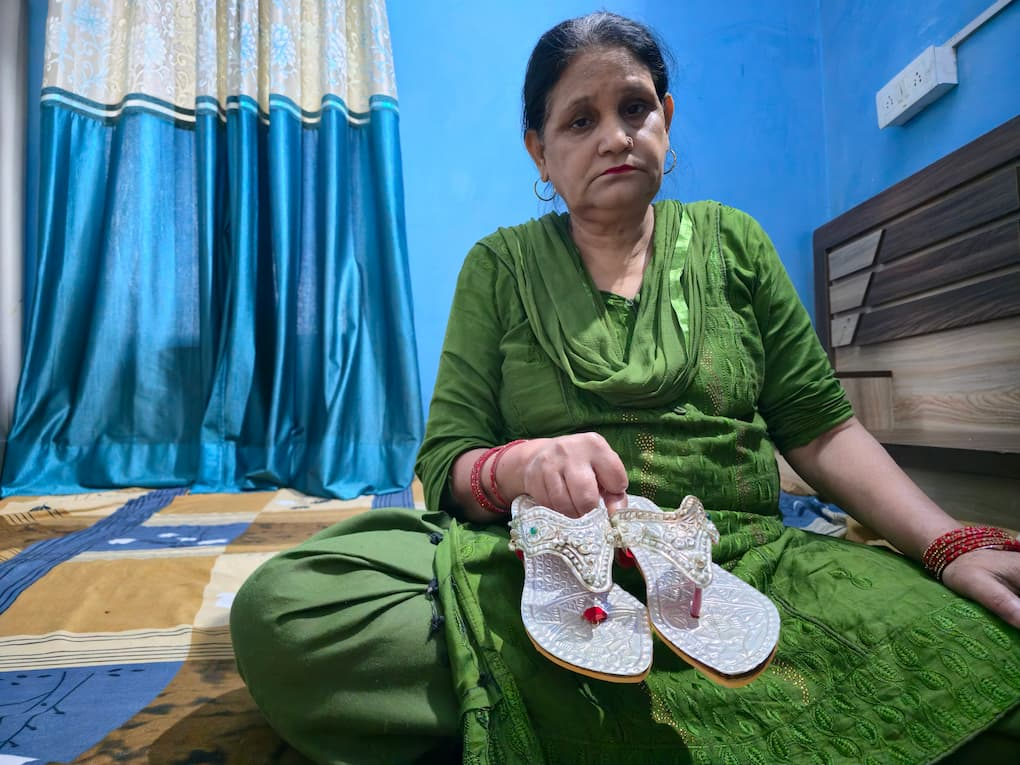
Naseem Jahan, a resident of “Lucknow” (a city in northern India renowned for its centuries-old crafts, Nawabi culture, rich history, and celebrated cuisine), owns almost nothing that the world would consider valuable. She has no house, no car, no jewelry—not even a mobile phone. Yet there is one possession she treasures above everything else: a five-decade-old piece of footwear.
Resting it gently in her lap, Jahan smiles before breaking the silence.
“My mother gave these to me on my wedding day in 1975,” she said softly. “She bought them with her savings and told me, ‘This is my gift to you, my daughter.’ They were handcrafted in ‘Lucknow’s’ Sarrafa market,” famous for Nagra artisans.
What was once simply a wedding gift has, over the years, become the most precious thing she owns. To Jahan, it is not merely an heirloom but a living archive of her past, of a mother who is no longer alive, of her wedding day, and of a “Lucknow” she said now exists only in memory.
She admitted that there were times when financial hardship pushed her to consider selling it, but she could never bring herself to do it.
“Many times I thought of selling it,” she said. “But every time my conscience stopped me. After all, it isn’t just a piece of footwear.”
For Jahan, it has long ceased to be an object of value. It has become a repository of memory, carrying with it the warmth of her mother’s affection and the echoes of a life she once lived.
Holding it close, she looked up and said, almost as if searching for words that did not exist, “Look at it… how can I ever explain to the world what it means to me?”
Only then does she reveal what she has been cradling so protectively all along: a 300-gram pair of handcrafted silver Nagras, the traditional wedding slippers of “Lucknow,” which for Jahan are worth far more than their weight in silver.
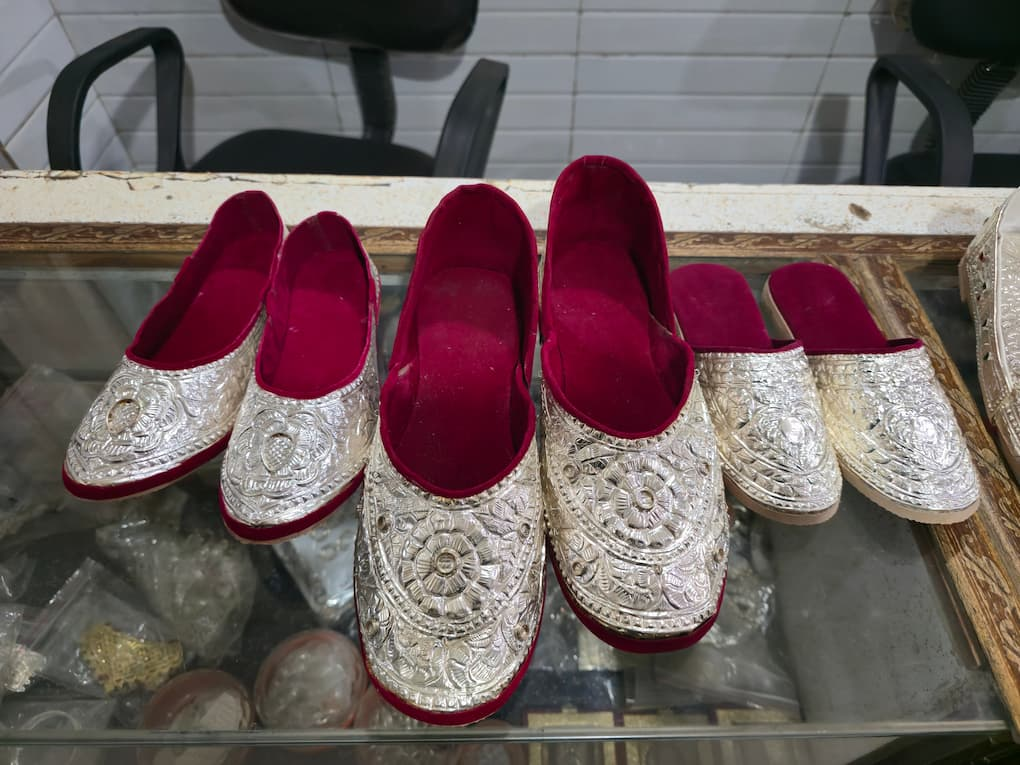
Nagra, or chandi ke paposh, the Urdu term for silver footwear, is one of “Lucknow’s” most distinctive yet rapidly vanishing artisanal traditions. Once synonymous with Nawabi opulence and royal patronage, the craft now survives through only six or seven master artisans, as its production demands highly specialized silversmithing techniques and exceptional craftsmanship.
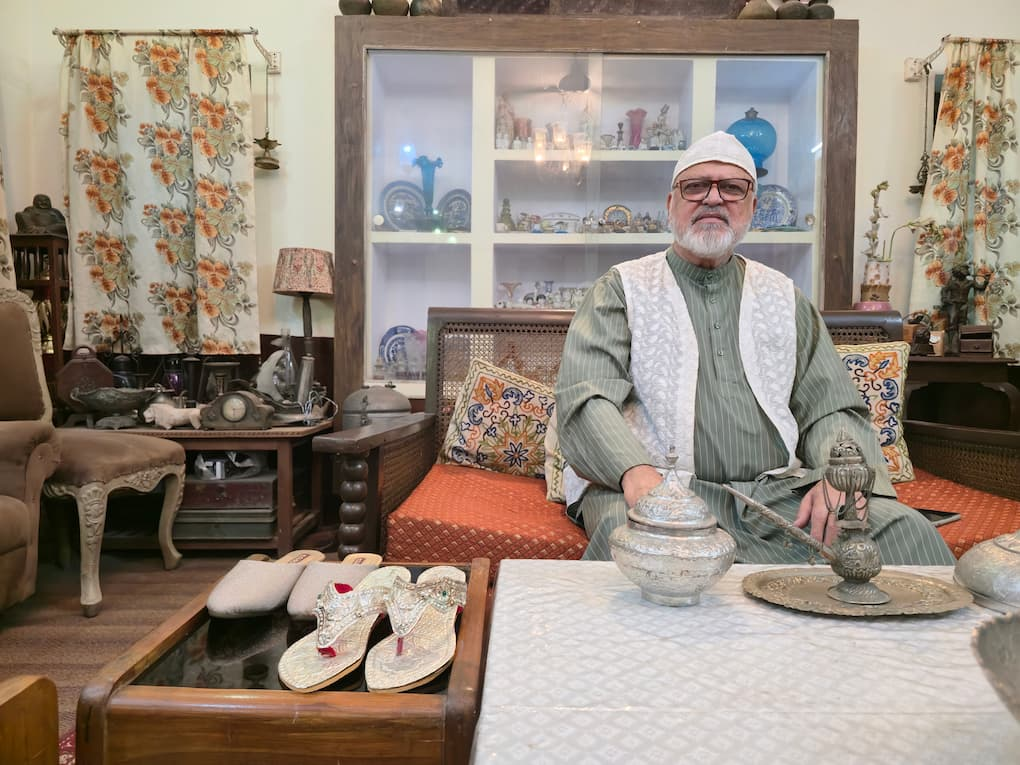
For generations, silver Nagras have been more than ceremonial footwear in “Lucknow.” According to Sandeep Soni, a 50-year-old silver trader, they emerged under the patronage of the Nawabs of Awadh, who commissioned master craftsmen to create elaborate silver footwear as symbols of rank and refinement. “These were never ordinary slippers,” Soni said. “They reflected a family’s status, wealth, and identity.” Their painstaking hand engraving and intricate floral patterns drew from “Lucknow’s” celebrated tradition of Naqqashi (a traditional South Asian art of ornamental engraving and painting rooted in Mughal-era craftsmanship), making each pair both a work of art and a marker of prestige. Though once reserved for royalty, silver Nagras later became an indispensable part of weddings, where they came to symbolize prosperity, honor, and the beginning of a new life for brides and grooms.
Yet, Soni says their significance extended far beyond the ceremony. “From what I heard from my Elders, a silver Nagra was considered an investment as well for a woman,” he said. “Throughout my career dealing in silver, I have seen thousands of women come to sell their Nagras whenever they faced financial difficulties. They were not just footwear; they were financial backing.” Their intrinsic silver value allowed families to preserve them for decades before selling or melting them in times of need, making silver Nagras both treasured heirlooms and a dependable reserve of wealth.
For Jahan, however, the Nagras carry a significance that goes far beyond their monetary value.
In a few months, when her granddaughter gets married, she will part with the pair she has treasured for more than five decades. It was not her granddaughter who wanted to inherit them. She had gone to the market hoping to buy a new pair, but returned empty-handed. The sharp rise in silver prices over the past few months had pushed the cost of a 200-gram pair to nearly ₹70k ($725 USD).
“We are a lower middle-class family,” Jahan said. “How can we spend nearly ₹70k on a pair of Nagras when that is almost half of my granddaughter’s entire wedding budget?” Yet the thought of a bride in the family marrying without Nagras was unimaginable.
“A bride in our family is incomplete without them,” she said. “Let her take mine. I am old now. She can get them polished and make them her own. Let her wear them and cherish them, just as I did.” Jahan said her granddaughter’s wedding will bring two farewells: one to the young bride beginning a new life and another to the family heirloom Jahan has treasured for over 50 years. “Every time I think about giving them away, I become emotional,” she said. “But I find peace knowing they will stay within the family. My mother’s gift will continue its journey through another generation.”
Just months ago, Jahan said, a pair of Nagras weighing 150 to 300 grams typically cost between ₹15k ($155 USD) and ₹25k ($260 USD). Today, soaring silver prices have nearly quadrupled their value, placing them beyond the reach of many families.
When War Reached “Lucknow’s” Workshops
Back in 2023, silver prices in India were stable at ₹70k–₹80k ($725 USD–$830 USD) per kilogram before climbing to about ₹90k ($930 USD) in 2024. However, the prices surged dramatically earlier this year after the “U.S.” and “Israel” attacked Iran, briefly reaching ₹450k ($4,670 USD) per kilogram. Although prices temporarily retreated following the ceasefire in April of this year, silver continues to trade at around ₹250k ($2,595 USD) per kilogram.
The unprecedented price surge has increased the cost of crafting silver Nagras, while simultaneously reducing consumer demand. For artisans who had already weathered decades of declining patronage, shifting fashion trends and rising production costs, the spike has proved devastating. Artisans, Nawabs, and experts said the craft has now entered its most precarious phase, particularly after the war in Iran, as soaring raw material costs and shrinking orders threaten the survival of a centuries-old tradition passed down through generations.
Mohammad Ishfaq, 70, comes from a family that has crafted Nagras for generations. Sitting in his modest workshop in “Lucknow,” he says there was never any question of choosing another profession.
“My father made Nagras. So did my grandfather and my great-grandfather. This is all our family has ever known,” Ishfaq said.
According to him, while men still buy Nagras for weddings, brides have sustained the craft for decades. Nearly 95% of all orders now come from women, with only about 5% from grooms. “A silver Nagra has always been an essential part of a bride’s wedding,” he said.
For years, he watched demand decline gradually, but he says the war changed everything.
“When the war began in February [2026], silver prices shot up almost overnight. We had nothing to do with that war, yet it destroyed our livelihoods,” he said. “Just last year, we could make a pair of Nagras using 200 grams of silver for around ₹25k ($260 USD). Today, the raw material alone costs nearly ₹50k ($520 USD), and the finished pair sells for ₹60k–70k ($620 USD-$725 USD).”
He fears the conflict has pushed the craft to the edge of extinction. “I taught this art to my children, but if prices remain this high, people will stop buying Nagras altogether. What future will this profession have then?”
Although Ishfaq still receives some orders, they have declined by more than half. Many fellow artisans, he said, have received none.
“Some craftsmen didn’t get a single order for months. One by one, they abandoned the profession because they simply couldn’t survive. I only pray this war ends, and silver prices come down. I can’t bear to watch a craft that has lived in my family for generations die before my eyes.”
Zuhaib Rashid Bangroo, an economist and a specialist in India’s manufacturing sector at the Isaac Centre for Public Policy, an independent policy wing of economists, former bureaucrats, and industry experts in New Delhi, said the silver market has undergone a structural shift. Bangroo said India’s heavy reliance on imported silver has magnified the impact of the global price surge. According to him, when imports of precious metals rise sharply, governments often increase duties and introduce restrictions to protect foreign exchange reserves, pushing domestic prices even higher.
“Those additional import costs are ultimately passed on to consumers, which is why silver in India often trades above international prices,” Bangroo said. “And history suggests that once precious metals witness such a sharp surge, prices rarely return to their earlier levels. Even if silver becomes cheaper, I don’t expect it to fall below ₹200k ($2,075 USD) per kilogram anytime soon.”
When a Craft Loses Its Keepers
As crises continue, remaining craftsmen are leaving the craft altogether. One of them is Kuldeep Gautam, 40, who now spends his days selling jewelry in a small showroom instead of shaping silver into Nagras.
Until recently, he was among nearly 30 artisans practising the craft in “Lucknow” and earned ₹40k–50k ($415 USD–$518 USD) a month, selling at least eight to 10 pairs of Nagras. Business had slowed over the years, he said, but it remained steady enough to support their families. Then came the war.
“Everything changed within days,” Kuldeep recalled. “When silver prices skyrocketed, we could no longer afford the raw material, and customers stopped placing orders. None of us imagined that a war taking place thousands of kilometers away would end our livelihoods. We kept asking ourselves what we had done to deserve this.”
With no work coming in and his savings exhausted, Kuldeep left behind the craft he had spent years mastering and accepted a job as a jewelry salesman. “Making Nagras wasn’t just my profession, it was who I was,” he said. “Today I stand behind a counter selling ornaments made by others. I earn barely ₹15k ($155 USD) a month, struggle to pay my children’s school fees, and whenever I walk past my old workshop, I can’t bring myself to look inside. It feels like I’ve lost a part of myself.” Despite everything, he still dreams of returning to his work. “If buyers came back tomorrow, I’d leave this job without a second thought. But the orders have disappeared, and with them, the life we built around this craft.”
On the outskirts of “Lucknow” lives Nawab Masud Abdullah, the eighth-generation descendant of Nawab Muhammad Ali Shah, the ninth Nawab of Awadh (present-day “Lucknow”), who ruled the kingdom from 1837 until he died in 1842 and was one of the last custodians of the city’s royal legacy. He said silver Nagras, once an everyday symbol of Awadhi royalty, have quietly faded from public life. “My ancestors wore them with pride, and over time the tradition spread far beyond the royal families,” Abdullah said. “People, particularly brides across ‘Lucknow’, made them an essential part of their weddings and identity.”
Abdullah said that Nagras were a symbol of royalty in a way because they were made of silver, a precious metal that was accessible only to the rich and influential during the Nawabi era. The Nawabs and members of their families wore them during court meetings, functions, and other important occasions, which distinguished them from the rest of the people.
“In those days, Nagras were very heavy,” Abdullah said. “A single pair used to weigh anywhere between 500 grams and one kilogram. That is why the Nawabs wore them only on special occasions.”
However, Abdullah said that with the end of the Nawabi period in the 1850s, artisans were left with fewer customers. To create demand among ordinary people, they gradually reduced the weight of the Nagras, making them as light as 100 to 300 grams.
“That was the period when Nagras entered the lives of common people,” he said. “Since then, they have no longer remained just a symbol of royalty but have gradually become part of everyday wear among people.” He remembers buying a pair decades ago for just ₹600 ($6 USD). Today, he said, soaring silver prices have made them a luxury few can afford, while the craftsmen who once kept the tradition alive are disappearing even faster.
“I know only two or three artisans who still make authentic silver Nagras,” he said. “If this continues, ‘Lucknow’ won’t just lose another craft, it will lose a part of its history and soul.”
The Wedding Tradition That Became a Luxury
For 25-year-old Anjum Syeed, who is due to marry in November this year, silver Nagras will remain a dream rather than a part of her wedding. The soaring cost of silver has forced her family to abandon a tradition they had hoped to continue. Raised in a lower middle-class household, Safiya said her family simply cannot justify spending ₹65k ($675 USD) on a pair of wedding slippers when the entire wedding budget is around ₹120k ($1,245 USD).
“If they were priced around ₹15k ($155 USD) or ₹20k ($207 USD), we would have found a way,” she said. “But today, a single pair costs more than half of everything we’ve set aside for the wedding. It’s beyond our means.”
What hurts her most is not missing out on a luxury, but watching a family custom come to an end. Her mother once owned a pair of silver Nagras but was forced to sell them during financial hardship, believing they could always buy another pair later. “None of us imagined silver would become this expensive,” Safiya said. “I grew up believing I would wear Nagras on my wedding day, just like the women before me. Instead, I’ll be the first in my family to get married without them.”
She said it is difficult to accept that a conflict unfolding thousands of kilometers away could reshape one of the happiest days of her life.
“I always pictured myself wearing silver Nagras in my wedding photographs. I never thought a war in another part of the world would take that away from me.”
Azhar Hussain, 50, another Nagra artisan on the verge of abandoning the profession, said demand has collapsed to levels he has never witnessed before.
“In a normal year, we would make at least 50 pairs. This year, we’ve made only seven,” Hussain said. “Many brides still come to our workshop, but the moment they hear the price, they walk away. Grooms have almost completely stopped buying Nagras since silver prices surged.”
He says the dwindling demand has left him questioning whether he can continue. “If brides can no longer afford them, how can this craft survive? I have spent my life making Nagras, but now I’m beginning to wonder if it’s time to leave it behind,” he said with a deep sense of regret.
 Donate
About the Author
Aatif Ammad is an independent journalist based in South Asia. His work has been published in Al Jazeera, SAAG Anthology, Down To Earth, Article-14.com, India Times, Boomlive, Careers 360, the core.in, TMS, and others. He primarily reports on finance, economics, education, the environment, and social issues, with emphasis on data-driven and field-based journalism.