

The Magazine
Joy Tonepahhote: Carrying On the Kiowa Beadwork Tradition
- By: Crushing Colonialism
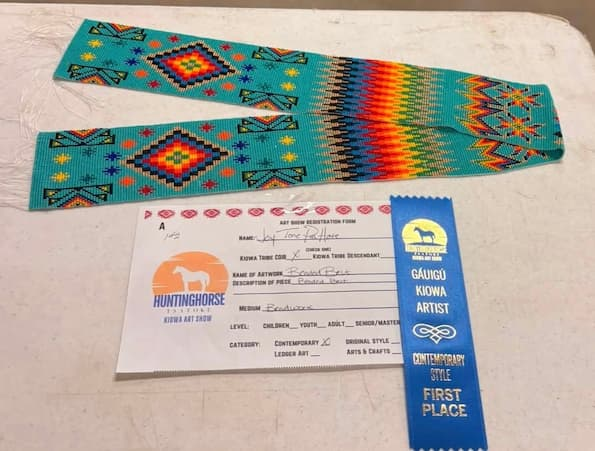
Award-winning Kiowa bead artist Joy Tonepahhote (Kiowa name Autoimah, “woman with a good heart”) has had her work exhibited at the Smithsonian’s National Museum of the American Indian and other museums across the “United States.” Tonepahhote reflects on continuing the beading tradition after her mother’s passing, honoring and preserving Kiowa culture through her art, and passing her knowledge on to future generations.
Editor’s note: This interview has been edited and condensed for length and clarity.
Tell me a little bit about how beadwork became part of your life. How did you get started?
My mother was a very well-known bead artist. Her name was Rosemarie Nez. And, of course, I would watch her bead, and I would ask, “Can I bead?” And my mother always told me, “No, these are my beads, this is my business, and this is my art. This is not something for you to play around with.” So, what she did over the years was create a want in me to do it.
One day, she said to me, “I have a bit of a headache. Why don’t you try to finish this little pattern that I have on my loom?” She would have a graph of the design, and you just had to follow the rows. I was so excited because it was the first time I was able to touch anything on her table. Then she gave me simple things to do, like little necklaces. And she allowed me to start working with her. I was doing dreamcatchers and making medicine wheels. And that’s how my beading started. And of course, watching her master her craft was amazing.
My mother always made all her outfits, my outfits, my kids’ outfits. She was the person who did everything. And then in 2005, we lost her to pancreatic cancer, and it was sudden. It was just—BOOM. Within a week, she was gone.
How did your mom’s sudden passing change your relationship with the craft?
After all the services, I sat down at her bead table. I was looking around. She had a lot of things on her table that she hadn’t finished. I thought, “You know, I’m going to finish those pieces so that her work is complete and she has nothing left behind.”
She was in the middle of making an outfit for my daughter. They were making a butterfly buckskin dress together, but I was stuck on the butterfly. No matter what I did, I wasn’t catching it. So, one night, I went to bed and had a dream about my mother. I told my daughter, “I was stuck on this, and Grandma came to me. She absolutely showed me how to do this.” So every once in a while, I’ll wake up from a dream about my mother, and I’ll have to sketch whatever she shows me for a new creation.
After she passed, I became the matriarch of the beadwork. And so, when everybody in our family needs stuff, I’m the one who will pump it out and make it.
For readers who may not be familiar with the Kiowa tradition, could you explain the significance of beadwork within that culture?
Beadwork is extremely personal. There’s a lot that goes into creating outfits for people. I need to know their background, what tribe they’re from, the colors the tribe uses, whether there are any logos, any colors you can’t use, and any special crests, crowns, or anything that needs to go in the beadwork to make it as personal as possible.
To be considered traditional, you have to understand and know what you’re wearing. The traditional beadwork that we do tells a story. It tells who you are, where you’re from, and who your family is.
The beadwork [color] is what really tells you what tribe or what area your tribe might be from. So the Sioux people use red, white, and yellow; the Iroquois use florals, purples, and strawberries; the Navajo people use browns and earth colors; and we, the Kiowas, have the standard black, blue, red, orange, yellow, and green— especially green or turquoise.
Beadwork also includes elements that represent family. So, within my family, we have what we call a waterbird. That waterbird is [something] I only create for my family. So now, you look at one of my daughters and their outfits, you can tell by the dress that she’s from the Southern Plains, right? You can tell by the colors: the black, blue, red, orange, yellow, green. And you can tell, then, by the waterbirds on her that she’s a Tonepahhote.
Beyond the designs themselves, are there beadwork techniques or methods that are uniquely Kiowa?
There are two main styles of beading. One is the loom work. That’s what I specialize in. They all have to match, be the same size, and lay flat. The other style is what they call lazy stitch, or appliqué, where it’s like five beads in a row. Most of the beadwork worn by Kiowa people is loom work.
You shared that your mother continues to guide your beadwork through dreams. Is dreaming of and receiving guidance from ancestors something that holds cultural significance within the Kiowa community, or is that a more personal experience for you?
That has been my journey. My mother and I were extremely close. I’d never had breakfast or dinner without my mother. And she helped raise my children with me while I went to school. If I didn’t have my mom to help me, I wouldn’t have been able to go to school because I couldn’t afford daycare. She was the foundation of who we are as women in my family.
Beyond traditional and ceremonial beadwork, do you ever create pieces simply because you’re inspired by a particular design or idea?
Oh absolutely. I mean, what I do is I just bead. So whatever comes across my mind today, I make. Because it’s not tribe-specific; it’s just something that came to me, and I thought, okay, let me fix that, let me make that, let me try that out.
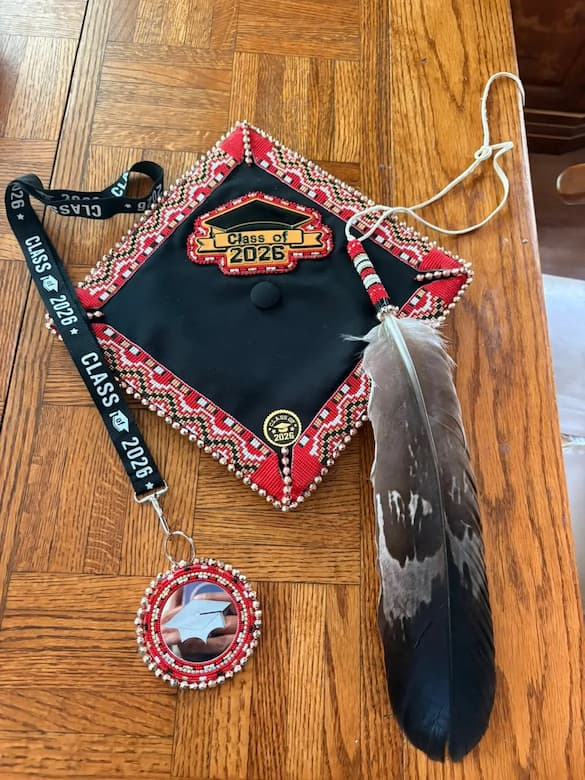
I do a lot of graduation stuff. Graduation, I think, is the most important for Native American students, whether it’s high school or college. I make a lot of medallions and necklaces for graduation. It’s all Native students; I don’t do it for anybody else. These are our people, and they’re going to be the people who are going to be stepping into the world to make decisions for us, and [I’m] hoping that being educated teaches them the skills and the ability to think critically so that they can make conscious choices that are going to be good for our people.
How does it feel to know that you’re the one carrying on your family’s beadwork tradition?
When I was asked to go to the Smithsonian, I thought they were teasing me at first. I didn’t realize I was creating a legacy. And then I started really looking at the stuff I was creating and thinking, “Wow, they can be considered art.” Then I got an invitation from Drexel University here in “Philadelphia,” and they asked me to be their artist-in-residence. And they did this huge display. And at the end of that, I had to do a lecture on my beadwork. That lecture was standing room only. I had no idea how many people were so interested in my work. And again, that was when I really thought, “Wow, you know? I’ve kind of made it.” It is really cool that so many people appreciate what I do.
The topping on the cake for me, though, was last year when my piece won first place [in the Contemporary Style category at the Kiowa Art Show] with my Kiowa people, meaning that they really… Well, I’m going to get emotional. They really appreciated what I made. Honoring me with that award is the epitome of all my work. It was so special for me because when you’re recognized by your own, it’s really a wonderful, wonderful feeling.
Have you shared this tradition with your children? Will they carry on the legacy?
When my daughters turned 18—I have two daughters—and graduated from high school, I made both of them fully beaded buckskins. And I told them, “That’s the last one I’ll make for you because now you need to learn how to make it yourself. I’ll help you, and I’ll guide you, but those are the last two that I’m going make for you.” I said, “You need to learn how to do this, because it’s just you.” Now both my daughters are able to bead and create and make for their children as well.
Are you doing anything currently to share the tradition with the public? Are you leading any workshops or classes?
I have an exhibit in October at Greater Valley Penn State, and they’re going to be doing a showcase of my beadwork with some other artists as well. Throughout the year, I’m asked to come in, demonstrate, show my beadwork, and then talk to a crowd. When I go to powwows, that’s where I display my big pieces, my big artwork, but I also try to educate, no matter where I am and what I’m doing, so that people walk away from my table knowing more than they did when they stopped. And I also let little kids touch the beads. I’ll put some in their hand and say, “See how small these are?”
When you think about the future of Kiowa beadwork, what gives you hope?
The Kiowa people’s understanding falls to education. I think educating people, Native and non-native, about who we are, how we came about, and how we are resilient and are still here, and that there are those of us who carry on that legacy of our people. I see a lot of educational language within my tribe; they’re having classes and doing things amongst themselves to generate a new desire for the younger generation coming along. And I think that’s a very positive thing and something that I definitely want to be part of.
 Donate