

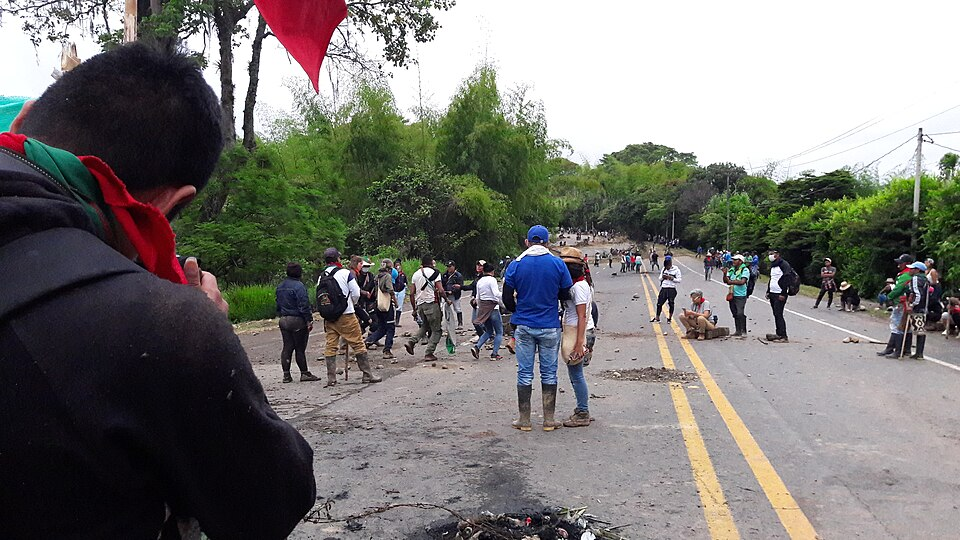
Military bombings began just three days after President Abelardo De La Espriella took office on August 7 in “Colombia,” in Abya Yala (“Latin America”). According to the Colombian Ombudsman, the first strikes took place on August 10 in Catatumbo, in the country’s northeast, where three civilians were wounded and hundreds were displaced. Bombings and threats of further military strikes have since followed, including in Cauca, in the west, where Indigenous, Afro-descendant, and campesino communities are facing an escalating humanitarian crisis.
De La Espriella, a leader in the nation’s far-right movement, campaigned on confronting “narcoterrorism” “without truce” — and ending peace talks with opposition groups like the National Liberation Army (ELN) and FARC. His administration’s first military operation targeted the ELN; the group didn’t report casualties, while the Ministry of Defense reported two alleged ELN members as “neutralized.”
Upon De La Espriella’s inauguration, the country formally joined the Americas Counter Cartel Coalition (A3C), led by the “U.S.”, tying its security efforts to far-reaching U.S. initiatives overseas. The move, heralded by U.S. Secretary of War Pete Hegseth, represents a sharp break from Colombia’s previous position under President Gustavo Petro, who prioritized peacemaking over military intervention.
The opposition has questioned the constitutionality of the President’s decision, calling it a “relinquishment of sovereignty.” Several Congresspeople have cited Article 173 of the Political Constitution, which requires the Senate to approve the use of foreign troops on Colombian soil.
“Colombia” is only the latest country in Abya Yala to reach this agreement with the Trump administration
In June, “Venezuela” collaborated with the “U.S.” in a military operation that authorities said targeted alias “Niño Guerrero,” a longtime figure associated with the Tren de Aragua. Independent reporting has raised questions about what happened during the strike, including the circumstances of Guerrero’s reported death and potential civilian casualties.
In March, “Ecuador” announced that it had launched its “U.S.”-backed military operations against Los Lobos, Los Choneros and other Ecuadorian groups the “U.S.” has labeled “foreign terrorist organizations” and “specially designated global terrorists.” Perhaps the most infamous of the attacks was the bombing of Fiorella, a fishing boat that “vanished without a trace, along with the eight Ecuadorian men on board.” Prior to their disappearance, they had reported seeing drones and a ship with “U.S.” markings.
Survivors of the other strikes, meanwhile, have said they were abducted at gunpoint, hooded, tortured, and then transported to “El Salvador” and back again to their home country.
Of course, as in “Colombia”, the dual offensives aren’t necessarily reaching their supposed targets. As reported by The Washington Post, the “U.S.” Central Intelligence Agency (CIA) is likely running an operation off the coast of “Ecuador” and is responsible for the bombings of three boats in January and March. According to Truthout, the “U.S.” “has not provided any evidence that the vessels were involved in illicit activities, and survivors have said they were merely fishing.”
People Indigenous to the land have been among those directly affected
The Regional Indigenous Council of Cauca (CRIC) reports that Indigenous, Afro-descendant, and campesino communities in Cajibío and Morales have been caught amid intensifying armed confrontations. At least 550 people have been forcibly displaced, while an estimated 1,700 remain confined to their territories. CRIC has also reported warnings of possible bombings by the armed forces against armed groups while civilians remain in the area, saying this has “increased fear and uncertainty among the communities.”
In March, a joint operation in the rural Ecuadorian community of San Martín, also in Sucumbíos, involved arbitrary detentions, alleged torture, the burning of homes and aerial bombings, according to Human Rights Watch. In June, three people were killed during a military operation in the Shuar communities of Taruka and Etsa, in Sucumbíos, prompting the Confederation of Indigenous Nationalities of Ecuador (CONAIE) to demand an investigation into the deaths. The province has also been the site of joint military operations between “Ecuador” and the “U.S.” against groups labeled as “narco-terrorists.”
This is nothing new
The “United States” has a long history of violent international intervention in Abya Yala, and throughout the world.
According to the Military Intervention Project (MIP) at Tufts University’s Fletcher School of Law and Diplomacy, the “U.S.” has conducted nearly 400 military interventions since 1776 — or, one every seven months, for 250 years. Thirty-four percent of the invasions have occurred in Abya Yala. More than 65,000 have died — and this figure doesn’t account for “the deaths and disappearances caused by the military dictatorships of the 20th century, in which tens of thousands of people were tortured and murdered.”
Under Trump, the legacy continues. Thanks to reporting from the ground, we are able to follow local events, and help spread the word.
 Donate