

The Magazine
Intywan Punllayanchik: We Rise With the Sun Inti Raymi: A Living Celebration of Kichwa Memory, Identity, and Continuity
- By: Adina Farinango
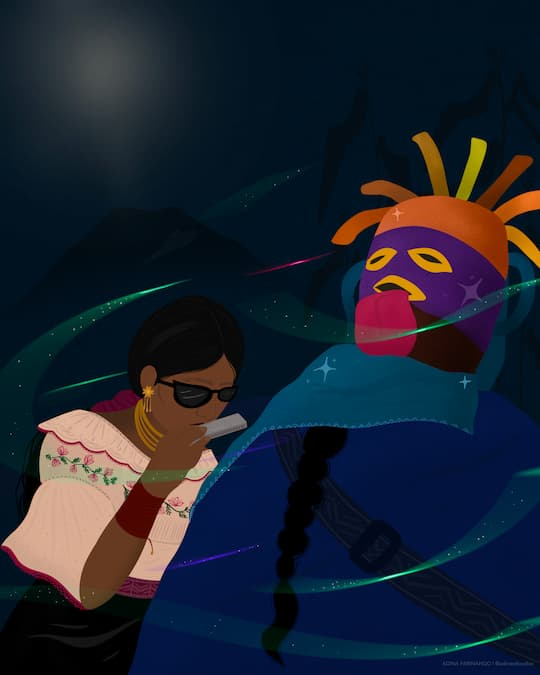
Every June for a whole week, I dance under the moon and watch the sun come out. My heartbeat aligns to the rhythm of the earth; my feet stomp to each beat. With every stomp, I awaken the land, myself, and the memory carried by Inti Raymi—the Kichwa celebration in “Otavalo, Ecuador”, that honors the sun, the harvest, and our ancestral connection to the earth. Between the sounds of flutes, harmonicas, guitars, and violins, I let the music carry me, my feet joining the circle in an unbroken rhythm. I find myself existing between dimensions, surrounded by the mountains that have watched over my family for generations. I exist in this space, and I realize that I am home. I am in the presence of all my community.
Being born and raised outside of my territory, in the diaspora of Lenapehoking (in “New York City”), taught me from an early age that no matter where the seed grows, the roots extend all the way back home. My homelands lie in Imbabura, a province in the northern Andes of “Ecuador.” The country is home to 800,000 Kichwa Otavalo people nationwide, known across “Ecuador” and around the world for our textiles, traditions, music, and Indigenous resistance. Beyond “Ecuador,” our community is also known worldwide for traveling across territories carrying our culture to every corner.
For the Kichwa Otavalo people, migration is both ancestral and contemporary—rooted in centuries-old trade routes while also shaped today by the economic realities that compel many to leave their communities. This is how I was born and raised outside my homeland. The reality of the Kichwa Otavalo community is that we are all over the world, carrying our culture with us—always keeping the body connected to the territory. Our traditions are so deeply embedded within our memory that colonial borders don’t exist; colonial calendars aren’t necessary for us to know that June is time to celebrate. Wherever we are, we will celebrate and adapt to our surroundings. Inti Raymi is a reunion, a symbol of gathering, whether we are in our territory or celebrating far from it.
Inti Raymi honors the sun, the winter solstice, and the earth, celebrating the reciprocal relationship between people and the land through gratitude for its abundance. It is a celebration of Allpa Mama, or Mother Earth, for the crops harvested, a celebration of gratitude to the sun and to all our surroundings, for everything that has nourished us throughout the year. It is a time of purification and reciprocity, where every element of nature plays a vital role in the ceremony. For nearly two weeks, we dance to unite our energy together and give it back to the land in an act of reciprocity.
My earliest memory of Inti Raymi is celebrating it from afar. Every year, our community gathered in a different rented venue, bringing together hundreds of Kichwa families traveling from neighboring states alongside Kichwas from various territories across “Ecuador.” It was days of back-to-back dancing, shared food, and community events. As a child, I did not question our celebrations. My mom would dress me, and I spent that time playing with other kids, occasionally going into the circle to dance with the adults. I did not realize then that for the adults, gathering was far more than a celebration. It was a necessity, a way to heal collective homesickness even for a little bit, to hold on to our roots and assert our presence away from our homelands. Even in the temporary rented spaces, the energy was undeniably strong. Through our music and our presence, we recreated the feeling of home, even far from “Otavalo.” The rhythm of our feet stomping carried a powerful force. As I grew older, I continued celebrating, dancing with intention and eventually picking up an instrument myself.
Although I had visited “Ecuador” as a baby, I was too young to remember it. It wasn’t until I returned as a teenager that I consciously experienced Inti Raymi in our homeland. Being able to move back and forth to and from “Ecuador” is a profound privilege—one that many members of my community are denied because of restrictive immigration policies. Migration has physically separated many of us from our Kichwa territory and traditions. Yet it is also the reason Inti Raymi continues to be celebrated far beyond “Ecuador,” carried across borders by those determined to keep our culture, identity, and community alive. This forced separation is exactly how celebrating Inti Raymi outside of the territory I was born in is important, and why it is carried so fiercely to this day. It is a powerful reminder that while migration policies may restrict our bodies, no colonial border can prevent our celebrations from enduring, reaffirming that body and territory are inseparable.
When I return to “Otavalo,” I fully immerse myself in what Inti Raymi means for my community: it is the time of year we all look forward to the most, an honor for the sun held in conjunction with our love for the Allpa Mama, our families, our cultural pride, and our gratitude for the corn that nourishes us. Living in the diaspora reshaped my relationship with Inti Raymi. I had to rediscover the celebration through the lens of our homeland and the community that has kept it alive. I found its meaning in the quiet moments at home with my family before the celebrations even began. There was a different kind of freedom in celebrating on our own territory, without the curfews that had shaped my experience elsewhere.
Going back to “Otavalo” allowed me to connect with Inti Raymi in a much deeper way. Dancing at the feet of Taita Imbabura and Mama Cotacachi, the mountains that watched my grandparents grow up, we moved in a circle around the musicians at its center. It was there that I learned every movement carried meaning and every ritual served a purpose. Dancing in a circle is a reminder that our communities remain united, bound to one another and to the land. The stomping of our feet is an act of waking the earth. Our dancing, music, and chants are all offerings, an act of reciprocity for the land. It is a time when the celebration fills our communities with a powerful, collective energy. We dance from home to home, where each family welcomes us with open arms. In return for the music we bring, they offer food and drink in an act of reciprocity and gratitude, sustaining both the celebration and those who carry it until sunrise.
There are so many layers to what I feel that I don’t think words could ever fully do it justice. More than a celebration, Inti Raymi is a ceremony—one that carries a profound spiritual and emotional power. I felt it most when I learned how to play the rondin and immersed myself even more deeply, moving from dancing on the outer circle to actively driving the energy of the dance circle. I came to understand that playing an instrument means guiding the energy of the people dancing, giving cues on when to change the circle’s direction, and guiding the dancers when to stomp harder. Learning how to play the rondin opened a new way of being part of this celebration. It transformed the way I experienced music, and the way I gave and received energy through it.
It is said that during Inti Raymi, the Ayas (or spirits) join us as we dance, moving alongside us throughout the celebration. I remember when I first joined the circle to play the rondin, I was nervous. But with time, I felt like I gained more energy and confidence. There was one moment, in particular, when I felt the Ayas join me in the circle. Their presence guided the connection between my body, the rhythm of the instruments, the force of our footsteps, and the land beneath us. For a brief moment, I felt transported somewhere beyond myself.
I dance hard for my grandpa and all my relatives who aren’t here anymore, so they can hear me and my music across galaxies and dimensions. I dance for my friends who can’t make it back to our territory because of migration and colonial borders. I dance for them, imagining them back home, and willing my stomps and energy to reverberate across the miles and beyond borders. When my feet strike the earth, I carry all of that energy into the circle with me. Each stomp becomes more than the weight of my own body—it is the collective force of everyone dancing beside me. Together, we stomp with such strength that the vibrations seem to travel across the land, connecting our communities, our ancestors, and the territories that hold our history.
Playing the rondin as a Kichwa woman is a powerful act. While women have always been central to Inti Raymi, playing instruments was rarely part of their role in previous generations. Today, as more of us take up the rondin and join the music, we are opening space for other women to do the same. According to the Andean agroecological calendar, used by the Kichwa Otavalo people, Inti Raymi is a time of masculine energy—a season associated with strength, vitality, and action. I can feel that energy moving through me. I stop worrying about how I dance or whether my steps are graceful. I simply surrender to the rhythm, stomping harder, moving more freely, as the shifting energies of the ceremony carry me. But as more women play, we are actively shaping the future of the celebrations for new generations, creating that future and seeing it happen in real time. It comes from a place of love for my culture. It is my responsibility to help carry this legacy forward and pass it on to the next generation, just as those before me shaped the person I am today.
Inti Raymi is also a political act. It asserts our presence in defiance of the forces that sought to erase this celebration through colonization, cultural suppression, and the imposition of foreign religious beliefs. Despite all of that, we are actively celebrating our traditions. We don’t need a national holiday to remind us to celebrate; we don’t need financial support to organize our celebration. We do it because it is a part of us. In recent years, the co-opting of celebrations has been more frequent, though the folklorization did not start with my generation. It has been happening for decades, becoming so deeply normalized that many don’t even question it. “Ecuador” loves to market itself as a proud “multicultural” country when selling tourism, yet the state becomes violent the moment that Indigenous people rise, asking for basic human rights.
The hypocrisy is everywhere: politicians using our traditional clothing for photo ops, non-Indigenous brands profiting off our “aesthetic,” the co-opting of our language, folkloric dance groups playing dress up in the name of “representation,” and tour companies selling packages to tourists to observe our ceremonies as if we were a spectacle in a zoo. Too often people take on our identity only when it benefits them, cherrypicking and choosing the parts that are convenient and profitable while discarding anything that makes them uncomfortable. They want the traditions without the responsibility, accountability, and the discomfort of confronting ongoing colonial violence.
This grounding is precisely why we must be specific about who we are. We have to define for ourselves what it means to be Kichwa today, especially as we navigate living in the diaspora across “North America”. There is a common tendency to treat Indigeneity as a broad label, or to equate it entirely with simply having brown skin and being from a Spanish-speaking country. But our social and political realities are different, shaped by very specific histories of colonization. Indigeneity is not a passive identity or a racial checkbox, and having brown skin or a Latin American background does not automatically make someone Indigenous. For me, it is a lived reality tied directly to community accountability, ancestral responsibility, and the active defense of our practices. It is also the commitment to keeping our traditions alive, carrying forward the knowledge, ceremonies, and ways of being that have shaped our identity across generations.
Celebrating Inti Raymi is being unapologetically Kichwa. No matter where in the world we are, we celebrate in the way we can, to manifest our presence, because the memory that lives within our body doesn’t let us ever forget who we are. It is an active inheritance that requires us to show up, breathe life into the melodies, and stomp the ground with intention. We carry it into the future, through our art, our music, making sure the youth sees that our culture is shaped and defined by us. When the younger generation watches us hold the rondin or lead the circle, they see themselves. Every June, as we welcome the sun with our music, our stomps are felt across the world, proving that no distance or border can stop us. In our territory, in the province of Imbabura, north of “Ecuador,” we welcome the sun once again, every year, surrounded by Taita Imbabura and Mama Cotacachi.

About the Author
Adina Farinango is an Indigenous Kichwa-Otavalo artist and designer based between Lenapehoking (“New York City”) and “Ecuador.” Her multidisciplinary practice explores Kichwa identity in the diaspora, the relationship between body and territory, and Indigenous Futurisms through illustration, photography, embroidery, and mixed media. Drawing from ancestral knowledge, memory, and cultural continuity, her work examines the ways Kichwa art and traditions are carried, transformed, and reimagined across generations. She has collaborated with Today at Apple, Design at Instagram, Brown University, Kichwa Hatari, NYC Department of Transportation, and Cultural Survival, among others. Learn more about her work at adinafarinango.com and follow her Instagram account @adinasdoodles.