

The Magazine
Ullamaliztli: The Hip Ball Game Indigenous Sports as Refuge
- By: Jesús A. Escandón
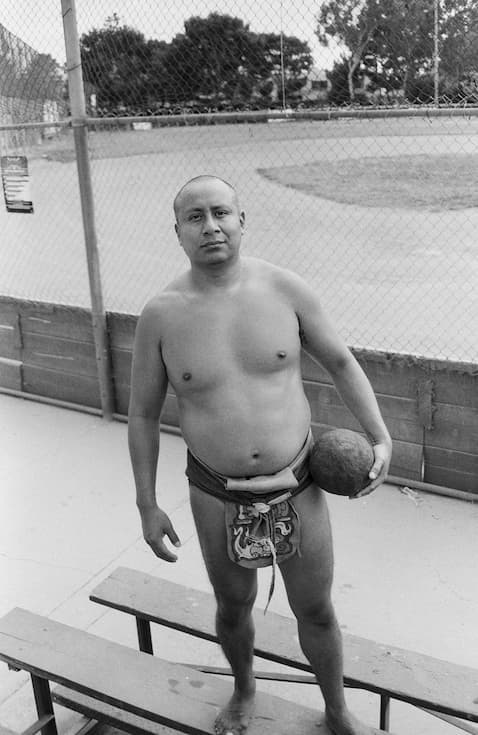
Long before modern sports filled stadiums, Indigenous Peoples across the Americas developed games that carried history, ceremony, and community traditions from one generation to the next. Today, millions celebrate sports such as soccer, basketball, and baseball, often without realizing that many of the games and ball traditions that shaped modern athletics have deep Indigenous roots. Archaeological evidence traces the game back more than 3,500 years to the Olmecs, regarded as the earliest civilization in Mesoamerica, making it one of the world’s oldest continuously practiced sports. Despite the widespread belief that colonization erased the tradition, Ullamaliztli has survived through generations of Indigenous communities and continues to be played today. I am Jesús Adrián Escandón, an Ullamaliztli player living in Huutngna, the ancestral village of the Tongva in present-day “South Los Angeles.”
In Nahuatl, Ullamaliztli translates to “playing with a rubber ball using the buttocks” and is commonly shortened to Ulama. In ancestral times, the sport was a means of replacing political warfare through gameplay—a sight of gambling and banter. In some communities, it was used to help resolve disputes, with the outcome determining the distribution of land or resources. But during the Spanish colonization of Mexico, the game was referred to as “the work of the devil.” As colonial authorities sought to dismantle Indigenous governance, spiritual traditions, and community life, Ullamaliztli was forbidden. Yet the tradition endured.
In Nahuatl, Ullamaliztli translates to “playing with a rubber ball using the buttocks” and is commonly shortened to Ulama. In ancestral times, the sport was a means of replacing political warfare through gameplay—a sight of gambling and banter. In some communities, it was used to help resolve disputes, with the outcome determining the distribution of land or resources. But during the Spanish colonization of Mexico, the game was referred to as “the work of the devil.” As colonial authorities sought to dismantle Indigenous governance, spiritual traditions, and community life, Ullamaliztli was forbidden. Yet the tradition endured.
Today, Ullamaliztli survives in the Mexican state of Sinaloa, where Indigenous communities have preserved their own regional style of the game for generations. The tradition has been safeguarded by families in the municipalities of Escuinapa and Mazatlán and, in recent decades, has spread to other parts of Mexico, including among Nahua communities in the central state of Puebla. The game continues to be played on a court known as a tlachtli (or taste in Sinaloa), preserving a practice for more than 3,500 years.
Ullamaliztli is experiencing a resurgence as Indigenous communities across Mexico and beyond reclaim the game as a living cultural tradition. I am proud to be one of its culture bearers and have just celebrated my first anniversary of being an Ulama ball player. Growing up, my parents constantly encouraged me to try different sports, but I was never enthusiastic about them. It wasn’t the lack of interest in a sport; rather, the “right sport” was never introduced. It was not until I witnessed my first-ever Ulama game played on my campus that I felt motivated, enthusiastic, and elated to participate and hold space in the traditional court.
Now, I am proud to be part of an international Ulama team, named Wehkah Kiskeh, meaning “They Come From Far Away” in Nahuatl. We practice every Sunday in the Tongva homeland. Now I know that I play to honor those who came before me, to make my family proud, and to help ensure this tradition continues for future generations. When I play Ulama, I tap into an ancestral way of life. The game immerses me in our language and worldview. My mother’s family is Nahua from the town of Coatzingo, in the Mexican state of Puebla, and I am just one of many Indigenous people working to keep our Nation’s traditions alive.
Interestingly, like many other Native cultures, the Western construct of gender and its prescribed roles is absent. In Ullamaliztli, this absence is expressed by both men and women being key and equal players in a game of reciprocity. This reflects the traditional belief that caring for one another is not a prescribed social role, but a shared responsibility woven into every aspect of life—even traditional sports. In the pueblos of Sinaloa, it is common to find that both spouses excel in Ullamaliztli, and this continues to be true through their children and community throughout. In a way, when each family member excels in Ulama, they also grow in their responsibility to their community and in living a good life. This sense of duality is central to revitalizing and learning about Indigenous cultures, as it reflects a worldview that transcends patriarchal norms and separates neither individual excellence from collective wellbeing nor sport from everyday life.
A seasoned and skilled player in our team, Stephanie Lozano, who is also a PhD Candidate in Archaeology at the University of California, Riverside, and focuses on Indigenous Mesoamerican worldview within the ancestral past, states, “Ulama as an ancestral tradition can bring us knowledge of our ancestral past that has been taken away from us due to the effects of colonization.” Stephanie continues to add that, “Ulama was not only a sport but was woven with ritual practices, science, astronomy, politics, and governance. The tradition is relevant today, especially in ‘Los Angeles, California’ because it reflects the ancestral knowledge from the community here. People of the American continents have been migrating for thousands of years and continue to do so through the ever-shifting control of the political borders.”
Stephanie notes that “Mesoamerican ancestral knowledge presented through Ulama has also migrated to ‘Los Angeles,’ which holds the largest diaspora of Mesoamerican people.” Unfortunately, many Indigenous and immigrant communities in the “United States” are currently living with fear of practicing their traditions amid increased Immigration and Customs Enforcement (ICE) raids.
However, Ullamaliztli endures as it always has in the past. It is still being played and carries the same sense of resilience and community it has for generations. More than a sport, it is a tradition grounded in physical and mental strength, collective identity, and solidarity—values that continue to sustain our communities through periods of uncertainty, discrimination, and injustice.
When we come together to play each Sunday, we do so knowing that our presence carries meaning beyond the game itself. Not only do we assert ourselves as strong and confident Indigenous athletes, but spread that same confidence throughout the park, letting everyone know that everything will be okay. We stand strong together and for one another, knowing that our presence also strengthens the young people and families who play alongside us. Oftentimes, even strangers who have never seen the Ulama game will be intrigued and stay long enough to watch us. As viewers witness the power behind each hit, they also become active participants, and together we are engulfed in that collective strength and power in which our ancestors also stood; strong for their families and beliefs, generations ago.
Beyond its physical demands, Ullamaliztli is rooted in a philosophy of reciprocity, balance, and collective responsibility. The game teaches that no player succeeds alone—each team’s effort sustains the match, reflecting the belief that a community thrives when its members support one another. At the center of this worldview is the Ule, the rubber ball, traditionally understood as a living representation of the sun. Keeping it in motion is a symbolic act of sustaining life, requiring skill, trust, and cooperation from every player on the court, as the heaviest ball can weigh up to nine pounds of pure natural rubber made from the sap of the rubber trees.
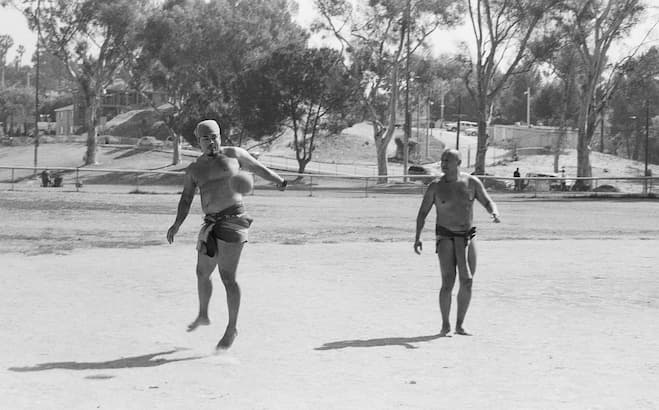
For team captain Marco “Kenwel” Santana, who is Masewal from the Pueblos of Tecalitlán, Jalisco, and Santa Martha Acatitla, Mexico City, preserving Ullamaliztli begins with simply playing it. “The game is preserved through play, or what we call pichoneo,” he says. “It has to be something people enjoy. In my opinion, the sport will be best conserved if you start within the family. It may be a challenge to involve everyone in your family, but introduce it to brothers, parents, cousins, and most importantly, your children. That way, it will interest someone, and they will continue it. But don’t just teach it as a simple sport; teach it as a tradition to respect; that way it is seen as valuable as it is.”
Every Sunday, Kenwel brings his children and relatives to practice, ensuring they experience Ullamaliztli not only as a sport, but as a living tradition that strengthens family bonds, reinforces community, and carries Indigenous values from one generation to the next. Aside from leading the team, captain Kenwel and his wife are both full-time students at California State University, “Los Angeles,” and are raising their children in the Ulama tradition.
For many Ullamaliztli players, preserving the game also means creating opportunities for others to reconnect with their culture and identity. As a student archivist at California State University, “Los Angeles,” I have advocated for the rematriation of Indigenous ancestral belongings while using my knowledge of the game to connect those pieces to the living traditions they represent. Together with my teammates, we have introduced more than 40 young people to Ullamaliztli through community workshops and have shared the game at universities, cultural events, and in a short documentary. Every match, workshop, and conversation is an opportunity to remind the next generation that their heritage is not confined to museums or history books—it is alive, carried forward through community, and strengthened every time the Ule is lifted into play.
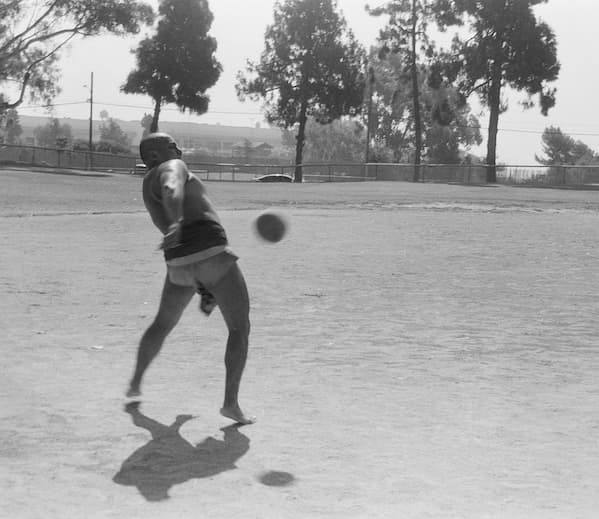
There are moments when I strike the ball so high into the sky that I feel deeply connected to my ancestors. As I watch the Ule rise toward the sun, I imagine carrying with it the strength, resilience, and prayers of those who came before us. In those moments, I can almost see my ancestors smiling, proud that we continue to honor them by keeping this tradition alive for our families, our communities, and the generations yet to come. As our team captain Kenwel said, “Putting on our atuendo is like stepping into the past and seeing how a traditional player would have dressed in more ancient times. The fact that we can still see that is resilience. What was once thought to be a dead sport is very much alive.”
Ulama is our testament to our ancestors belonging to this continent. We are not birthed from fear, but from a people of immense bravery. As strong and high as the sun’s rays, we will continue to exist another 3,500 years and beyond. Our hearts beat the same tempo as the Ule and in rhythm with Mother Earth, and that is infinite. Life is made up of creation and our traditions, and our traditions are the creations that honor our lives. This is a never-ending cycle. As we pass the Ulama tradition along to our younger generations, we infuse them with the strength, power, and resiliency of the ancestors before us. By carrying on the tradition of Ulama, they will continue to survive and resist anything that the future throws at them.

About the Author
Living in Huutngna, the ancestral village of the Tongva in present-day “South Los Angeles,” Jesús Adrián Escandón is a P’urhèpecha and Nahua artist. His focus lies in both contemporary and traditional art mediums, including but not limited to writing, drawing, painting, beading, sculpting, and textile production, highlighting the beauty of his People and Culture while offering the complex contemporary image that mainstream media fails to recognize. When not partaking in the arts, Jesús finds himself in the educational space spreading traditional knowledge to other institutions and his current workspace: California State University, Los Angeles, Special Collections.