

The Magazine
Beyond Visibility: Indigenous Power and the Contradictions of COP30
- By: Natalia Figueredo
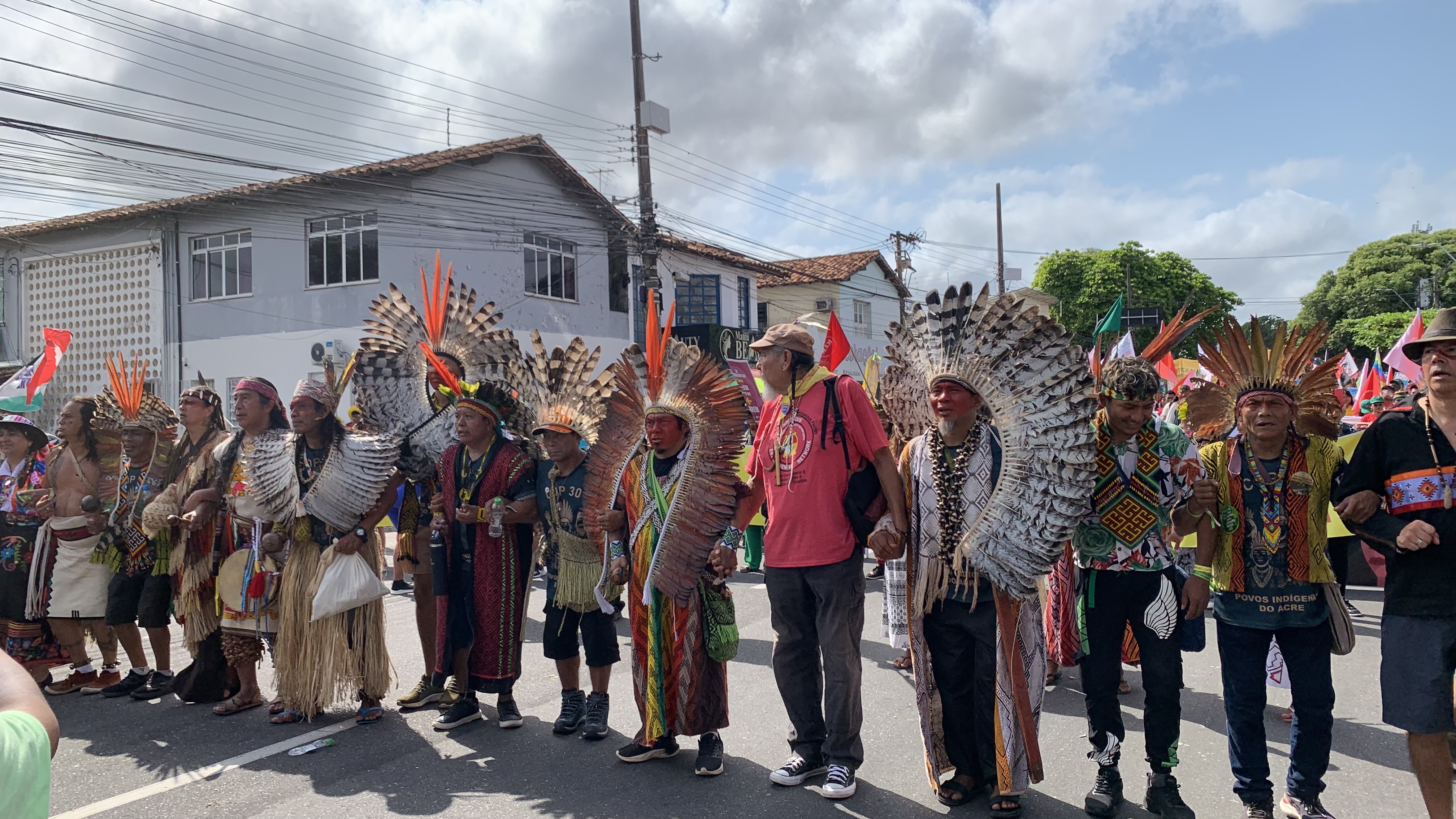
COP30 began long before its official opening on the 10th of November, 2025, in the Brazilian city of Belém. In the days before, Indigenous leaders, Afro-descendant communities, riverine and other water and land-based communities, and social movement activists traveled for days to reach Belém, the second-largest city in the Brazilian Amazon. Across the city, banners and chants repeated a clear message: “We are the solution.” The slogan emerged from a campaign initiated by Indigenous peoples of the Amazon and later taken up by Indigenous communities across Latin America in the lead-up to COP30.
Indigenous demands circulated in Belém during COP30 through marches, assemblies, cultural spaces, and official meetings, centering calls for the legal recognition and protection of their ancestral lands — territories they have inhabited and governed for generations. Alongside demands for direct access to climate finance and meaningful participation in decision-making spaces, Indigenous leaders insisted that territorial rights are a precondition for any credible climate action.
It was the organized presence of Indigenous delegations and their demands for recognition of their land rights that set COP30 apart and made Belém feel different from previous climate summits. Reflecting how Indigenous peoples and grassroots organizations shaped the atmosphere and political tone of the summit through their expressive presence in the city, COP30 quickly became known in Brazil as COP do Cocar or “the COP of the feather headdress” and “the COP of social movements.”
Holding the conference in the Amazon carried both symbolic and strategic weight. As the world’s largest tropical rainforest, the region plays a central role in regulating global climate. Amazon is also an Indigenous land shaped by Indigenous governance, alongside extractive pressures and long-standing conflicts over territory.
The early announcement of broad Indigenous participation further encouraged delegations from other regions of the world to travel to Belém. In total, the conference brought together roughly 5,000 Indigenous people, with about 900 accredited to circulate within the Blue Zone—the UN-managed area reserved for government delegations, observers, and authorized participants—marking the largest Indigenous presence ever recorded at a UN climate summit. According to Brazil’s Ministry of Indigenous Peoples (Ministério dos Povos Indígenas, MPI), participants represented 385 Indigenous communities worldwide.
Since the Conference of the Parties (COP) remains one of the few global spaces where states—197 countries and the European Union—discuss responses to the climate crisis in a multilateral setting, it represents a unique opportunity to advance claims for climate justice and to ensure the inclusion of Indigenous peoples, land- and water-based communities, and urban populations in decision-making. These groups are among those most affected by the ecological crisis, and the decisions negotiated at the summit shape climate policies, financing, and projects that directly impact their territories and lives. For these groups, engaging with the COP process is essential to question how climate action is defined, implemented, and distributed.
Despite being marked by unprecedented popular mobilization, for many Indigenous peoples, this summit was also one of the most frustrating and disappointing experiences. First, the Blue Zone —the UN-managed area reserved for authorized participants— functioned as a visible boundary between participation and authority. Indigenous leaders and allied movements encountered restricted access and limited speaking opportunities. Numerous accounts described Indigenous representatives remaining largely in the corridors of the Blue Zone instead of participating directly in the negotiation rooms where decisions were made.
Second, Indigenous leaders repeatedly called out institutional spaces for dismissing their knowledge, authority, and role in shaping climate policy. While heads of state, diplomats, and corporate lobbyists debated infrastructure projects, energy transition plans, and financing mechanisms inside closed negotiation rooms, Indigenous representatives, though physically present, were often excluded from active decision-making.
During COP30, Brazil’s Minister of Indigenous Peoples, Sônia Guajajara, emphasized that Indigenous peoples worldwide share a common struggle for guaranteed rights. Inclusion often did not mean sharing power. Instead, it created the appearance of openness while decision-making remained in the same hands. This helps explain the frustration expressed by many Indigenous leaders. The COP became a space where Indigenous peoples were visible, but their ability to influence negotiations, shape final texts, or direct climate finance remained limited.
This exclusion was particularly consequential because Indigenous movements were not only presenting policy proposals. They were defending a different political practice, one that recognizes rivers, forests, mountains, and other living beings as part of a shared political community. In this worldview, humans are not separate from nature or positioned above it, but interdependent participants within a larger web of life.
COP30 was a decisive moment to bring these proposals into the center of global negotiations. The conference was widely framed as the “COP of delivery”, when governments were expected to turn past promises into concrete action. This included updating national emissions reduction targets, advancing plans to move away from fossil fuels, and delivering long-promised climate finance to developing countries. In other words, COP30 was meant to redefine how the global community would respond to an escalating climate crisis.
If COP30 was about implementation, it also had to deliver on commitments already made to Indigenous peoples. The calls heard in the streets of Belém and inside the Blue Zone were not new. Since the adoption of the Paris Agreement in 2015, countries have formally recognized the importance of Indigenous territories and knowledge in climate action. Globally, Indigenous peoples make up less than 5% of the world’s population and are widely recognized as stewards of the planet’s most biodiverse territories. In this framing, Indigenous governance appeared not as a cultural add-on, but as an environmental practice grounded in enduring relationships between people, land, water, and forests.
Yet this recognition has not translated into material support. Despite this central role, less than 1% of international climate finance reaches Indigenous peoples and their organizations. At COP30, Walter Kumaruara of the Kumaruara people from the Lower Tapajós participated in the “Agente Cobra,” or “We Charge,” campaign, organized by the Alliance of Peoples for the Climate, a Brazilian coalition of Indigenous peoples and other forest- and river-based communities.
“The impacts of the climate crisis in our territory are severe, but there are still many bureaucratic barriers that prevent us from accessing existing funds. There is no point in creating projects to finance change if the resources never reach the communities. And the countries that grew rich at the expense of others must pay this historical debt.”
While Indigenous leaders pushed for territorial protection and for recognition of their life systems — in which rivers, forests, and mountains are treated as living relations — governments and corporations advanced a different vision of climate action.
One central proposal advanced by governments, lobbyists, and corporations frames the energy transition as a pathway to the future, centered on the expansion of technologies designed to reduce pollution. This approach contains a structural contradiction, because technologies required for this transition depend on large-scale extraction of minerals such as lithium, copper, cobalt, and rare earth elements, often located in Indigenous and rural territories. In this sense, so-called green solutions risk reproducing the same extractive pressures that have historically threatened those lands.
These contradictions became visible on November 14, when Munduruku Indigenous people from Brazil’s Tapajós region blocked the main entrance to the COP30 Blue Zone. The protest targeted plans to dredge the Tapajós River for private operators amid renewed extractive pressure in the Amazon. Protesters also demanded the removal of carbon credit projects from their territories. They denounced these schemes for turning forests into financial assets, restricting traditional practices while allowing major emitters to offset their pollution without changing extractive economic models. For the Munduruku, both dynamics threaten sacred territories, public health, and ways of life already impacted by mercury contamination from illegal mining. Access to the Blue Zone was restored after a meeting with COP leadership and government ministers.
At this point, the conflict is no longer only about how fast extraction happens or how efficiently projects are implemented. It is about how land and territory are understood. For many Indigenous communities, land is not inert matter or raw materials to be exploited. They are living parts of a shared world, inseparable from memory, spirituality, livelihood, and collective responsibility. When a landscape is treated as a carbon storage site or a mineral deposit, the impact goes beyond economics. It reshapes the relationships that sustain life in that place and community. What is displaced in this process are different ways of living within the territory, where rivers, forests, animals, and other living beings are recognized as relatives and political actors, not resources to be managed.
Many of the climate solutions advanced at COP30 — including large-scale renewable energy projects, mineral extraction for batteries, and carbon market mechanisms — are grounded in a model of development shaped by modern industrial society. This model, which expanded globally through colonial expansion, defines land primarily in terms of economic value and resource potential. Justified in the name of “development” and “growth,” these projects frequently depend on expanded access to land, water, and minerals, particularly in the Global South. Even though presented as responses to the climate crisis, many of these proposals extend familiar extractive and colonial logics.
This tension calls into question not only who gets to decide, but what is being decided in the first place at climate conferences. Indigenous delegates were welcomed without altering the political frameworks that have historically structured climate negotiations and have, at the same time, invisibilized, marginalized, and inflicted violence on Indigenous life and territories. Inclusion in this context operates as a form of othering, as Indigenous peoples are incorporated in ways that allow states and institutions to present themselves as diverse and inclusive, while Indigenous demands, territorial claims, knowledge, and ways of composing the world remain constrained within the negotiation process. Othering, in this sense, is produced not only through exclusion but through forms of inclusion that preserve dominant frameworks.
Indigenous movements advance a different political practice. Their claims are not based only on identity or cultural difference. They reflect distinct ways of understanding territory, life, and responsibility. Rather, they are plural because they bring into the political arena nonhuman entities—rivers, forests, and territories—as actors, challenging political models that restrict decision-making to human interests alone. This is why framing the ecological crisis as a crisis of a civilizational model, or invoking autonomy as a political horizon, is not rhetorical. When Indigenous communities say, “we are the solution,” they are not referring to a specific group or territory, but to an understanding of the world grounded in relational forms of life. From this perspective, the transitions call for a broader transformation away from colonial and extractive narratives and practices, toward forms of coexistence capable of sustaining multiple worlds.
Even though COP30 was held in the Amazon as a sign of climate urgency, the conference showed that climate governance still treats the crisis mainly as a technological problem. Indigenous communities offer a different starting point. Instead of organizing territory through extraction and external control, they rely on long-standing forms of land management that produce abundance rather than scarcity, sustaining ecological continuity and collective life, as evidenced by the enduring presence of all forms of life in these territories. In this sense, It is not a proposal for the future, but an existing response to the crisis. It also reveals the limits of climate solutions that are disconnected from the territories they aim to protect.
This tension unfolded at a moment when multilateralism itself is increasingly challenged by the rise of authoritarian politics worldwide. What comes next will depend on whether future negotiations move beyond visibility and parallel participation to confront the structural changes that a genuine response to the climate crisis demands. Without decision-making arrangements that redistribute power, align climate finance with territorial rights, and enforce protections where forests are already being sustained, climate governance risks reproducing the very inequalities it claims to address and, ultimately, undermining its own legitimacy as a central space for global climate deliberation.

About the Author
Natalia Figueredo is a Latino-Amazonian architect, urbanist, and researcher from Brazil based in Barcelona. She is currently a PhD candidate in Anthropology at the University of Barcelona, where she researches urban development in Amazonian territories. She is also a member of the Observatory of Urban Conflict Anthropology (OACU) and collaborates with the European project Sonic Street Technologies, researching sound technologies in urban Amazonia. Her work engages research and communication through artistic practice, sound experimentation, writing, and lecturing, operating at the intersection of urbanism, cultural studies, and urban anthropology. Drawing from her Amazonian roots and global dialogues, her research focuses on critical ecologies, decolonial thought, and feminisms, challenging dominant ideas of territory, knowledge, and power.