

The Magazine
Identity Crisis: A Legacy of U.S. Indian Boarding Schools
- By: Shana Baumgartner
My grandmother passed away when I was 16 years old. It was a devastating loss and my first real grief. I was close to her, and her death was unexpected. At her funeral, I saw pictures of her that I had never seen before. A young face in black-and-white stared at me, and I felt a second wave of grief—for the person she never talked about. A version of my grandmother I never got to know.
Growing up, my Oglala Lakota grandmother did not speak of her childhood. She was born on the Pine Ridge Reservation in “South Dakota” in 1914. My grandmother had a cekpa, a turtle-shaped pouch that carried her umbilical cord and signified her ties to her home, her culture. She never wore it. She kept it hidden away, stored in a green beaded bag her mother (my great-grandmother) made her. She kept a lot of her nativeness hidden away for most of her life. As an Indian Boarding School survivor, she learned at an early age to be ashamed of her indigeneity.
For many Indigenous people, identity is deeply intertwined with history, trauma, and survival. For descendants of Indigenous boarding school survivors, like me, identifying as Indigenous can feel like walking a tightrope—between honoring a heritage and navigating a legacy of forced assimilation, cultural erasure, and systemic trauma. I have struggled all my life with identity. Identifying as Oglala Lakota seems disingenuous—after all, I was not raised with the culture. I am two generations removed from the reservation. But what is the consequence of not acknowledging this heritage? Denying that I am, in part, Oglala Lakota would mean that the erasure efforts of assimilationists succeeded.
In my quest to reconcile my identity and reconnect with my grandmother and her heritage, I began to research Indian Boarding Schools (as they are called in the so-called “United States”). What it turned into was more of a “wild goose chase,” and each resource I came across provided limited information. I was chasing sources and trying to piece together the part of my grandmother she never talked about—but the details were not there. And the search was not easy. I checked census records and searched for student enrollment data. Much of this is still not digitized and therefore not easily accessible. I sought out survivor accounts, particularly from the 1920s, to try to understand what my grandmother experienced. But many survivors, particularly from my grandma’s generation, kept silent.
What I learned in my “wild goose chase” over the years reads like a textbook:
There were many wars between white Americans and Indigenous tribes in the 17th, 18th, and 19th centuries. Whites wanted land. The Natives had land. But wars are costly. In the 19th century, the focus started to shift. Reformers began to view the solution to the “Indian Problem” differently; rather than killing Indigenous people with guns, they aimed to “kill the Indian” through education.
White Americans considered themselves civilized and superior. The Indigenous people—with customs and traditions that were so different from those of whites—were seen as inferior. “Indians” were deemed “savages” and whites saw themselves as the ones who would “civilize” Indigenous children. While outwardly appearing benevolent and philanthropic, the truth of the matter was that these Indian Boarding Schools were a form of cultural genocide, very openly aiming to dismantle Native traditions, language, and spirituality and replace them with white traditions, the English language, and Christianity.
In 1819, Congress created the Civilization Fund, which set aside $10,000 annually to fund schools for the purpose of “civilizing the savages.” By 1825, there were 38 of these federally funded schools in operation on reservations, primarily run by missionary groups and churches.
As whites continued to claim and settle the land, the question of what to do with “Indians” came to a head: civilize and absorb them into white society or exterminate and annihilate them? While taking Native lands and killing Native people continued, philanthropists and reformers in the East began to rally around the idea of assimilation as a more humane solution.
As the focus turned to assimilation through education, Indian Boarding Schools started popping up off the reservations. The belief was that for children to truly assimilate, they needed to be separated from their families to remove the home influence and the ties to their Native traditions. Carlisle Indian Industrial School in Pennsylvania was the first of such off-reservation schools. Its motto, as famously stated in a speech by its founder and superintendent, Captain Pratt, was to “kill the Indian… and save the man.” But Captain Pratt took assimilation further, believing that Natives should be denied land altogether and their children should be distributed among American families across the nation to be fully indoctrinated into the American way of life. By 1891, Congress made it compulsory that Indigenous children in the so-called “U.S”. attend these schools—some children were even rounded up by police. Two years later, the government started withholding resources from families who did not send their children to these schools.
While I do not have firsthand insight into my grandma’s personal experience, there are some commonalities amongst those who attended these Indian Boarding Schools, particularly in the early part of the 20th century: Indigenous children were separated from their families—some parents never saw their children again. Children were stripped of their clothes and provided with new clothes. Their hair was cut. Their names were changed. They were forced to speak English and punished for speaking their Native language. They followed a regimented, militaristic schedule and were taught vocational skills.
While this in itself is traumatic, there are many reports, particularly in the early years of boarding schools, but even into the mid- to late-20th century, of abuse—emotional, psychological, physical, and sexual. Corporal punishment was common.
It was widely reported that children were malnourished and often did not receive sufficient medical attention. In 1926, at the request of then-U.S. Secretary of the Interior Hubert Work, an official study was conducted on the conditions of the Indigenous populations across the U.S. The resulting report, published in 1928, known unofficially as The Meriam Report and officially as The Problem of Indian Administration, was the first general study of the conditions of Native populations since the 1850s. In the report, it stated “frankly and unequivocally that the provisions for the care of Indian children in boarding schools are grossly inadequate.” Furthermore, it stated “The fundamental importance of community life, like that of family life, has apparently never been recognized by the government in the treatment of the Indians . . . The forcible removal of whole tribes to very different physical environments resulting in the disruption of economic life, the detention of large groups as prisoners of war for long periods, the common discouragement of Indian leadership on the reservations and in the government schools, the disrespect of white employees for Native customs and ceremonies, and the assumption on the part of teachers and others in the schools that all Indian ways are bad ways, have tended to break down native social structure.” While this report marked a turning point in how people viewed the assimilation efforts, Indian Boarding Schools continued to operate and exist into the late 20th Century. Some still operate today.
In 2021, with the appointment of Deb Haaland as the first Indigenous U.S. Secretary of the Interior, came the establishment of the Federal Indian Boarding School Initiative in an effort to investigate the legacy of U.S. Indian Boarding Schools and the subsequent intergenerational impact and trauma. In Volume 2 of their Investigative Report (2024), the Department recognizes the existence of 417 official Federal Indian Boarding Schools across 37 states or then-territories in the U.S. and another 1,025 unofficial institutions with similar assimilationist education policies.
My grandmother survived. Not every child sent to an Indian Boarding School did. The Federal Indian Boarding School Initiative Investigative Report (2024) confirms that at least 973 Indigenous children died while attending U.S. Indian Boarding Schools. But with inadequate recordkeeping by those running these schools over the years, that number is likely higher. Carlisle Indian Industrial School (now home of the U.S. Army War College) still has a cemetery on its grounds with the graves of at least 187 Indigenous children who died while attending school there. It is unclear why these children’s bodies were not sent back to their families originally, though contemporary efforts have been made to disinter and repatriate them to their families and Native lands.
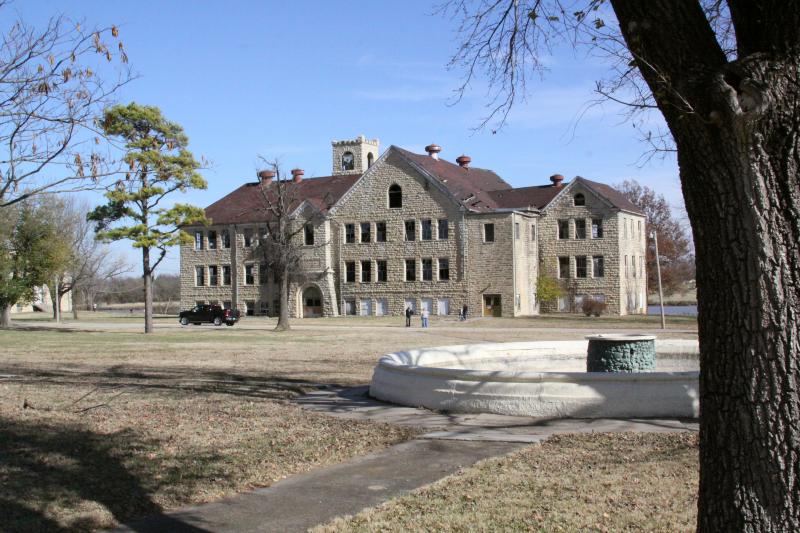
What I did not find in books or on websites was my grandma’s story. For that, I had to reach out to family members and use my imagination. My grandma was sent as a child to Haskell Institute, an off-reservation Indian boarding school in Lawrence, Kansas. According to my aunt, our family genealogist, my grandma was just 5 or 6 years old. While I cannot know her experience, I can imagine how traumatic it must have been. Traveling as a 5-year-old girl—without her family—presumably by train, across several states. Unable to speak the English language, she heard it spoken around her. Unsure of what she had to face at the end of her journey. My heart breaks for her.
What happened at Haskell Institute in the 1920s during my grandmother’s formative years—I won’t ever know. She was silent. She was silenced. Regardless of how she faired at the boarding school, receiving an education founded on the belief that her Indigeneity made her inferior had a major lifelong impact on her and a reverberating impact on her descendants. While the U.S. government’s effort to research this painful time in U.S. history is stalled due to defunding and a shift in current administrative priorities, the need for further research and truth-finding is key for healing. It is up to me—and other descendants of Indian Boarding School survivors—to keep pressing for the truth, raising awareness, and calling for reconciliation.
I have carried the weight of inherited shame, silence, and fractured identity passed down to me by my grandmother, a legacy of an abusive assimilationist education. But in 2019, 100 years after my grandmother took that lonely train ride across states that changed our family forever, I traveled with my relatives to Pine Ridge Reservation. I got my tribal ID. I held it in my hand and wept.
Adams, D. W. (2020). Education for extinction: American Indians and the boarding school experience, 1875-1928 (2nd Ed.). University Press of Kansas.
Bear, C. (2008, May 12). American Indian boarding schools haunt many. NPR. https://www.npr.org/templates/story/story.php?storyId=16516865#:~:text=American%20Indian%20Boarding%20Schools%20Haunt%20Many%20%3A%20NPR&text=American%20Indian%20Boarding%20Schools%20Haunt%20Many%20The%20U.S.%20government%20operated,Indians%20on%20and%20off%20reservations
Capriccioso R. (2010, January 13). A sorry saga: Obama signs Native American apology resolution; fails to draw attention to it. Indian Country Today. Indian Law Resource Center. https://indianlaw.org/node/529
“Carlisle Federal Indian Boarding School.” National Park Service. https://www.nps.gov/cibs/index.htm
“Carlisle Barracks Main Post Cemetery.” Office of Army Cemeteries. https://armycemeteries.army.mil/Cemeteries/Carlisle-Barracks-Main-Post-Cemetery
Hopper, Frank. “The Fight to Repatriate Indigenous Students Who Died at Boarding Schools.” YES! Magazine, 14 May 2025. https://www.yesmagazine.org/social-justice/2025/05/14/edward-spott-carlisle-boarding-school-journey-home
Lajimodiere, D. K. (2019). Stringing rosaries: The history, the unforgivable, and the healing of northern plains American Indian boarding school survivors. North Dakota State University Press.
“List of Indian Boarding Schools in the United States.” The National Native American Boarding School Healing Coalition. https://boardingschoolhealing.org/list-of-indian-boarding-schools/
Mejia, Melissa. “The U.S. History of Native American Boarding Schools.” The Indigenous Foundation. https://www.theindigenousfoundation.org/articles/us-residential-schools
Montgomery, L. M. and C. Colwell. (2020, March 5). Native American children’s historic forced assimilation. Sapiens . [Photo Essay] https://www.sapiens.org/culture/native-american-boarding-schools-photos/
National Native American Boarding School Healing Coalition. (2025). Indian boarding schools in the United States. Minneapolis, MN: National Native American Boarding School Healing Coalition. https://boardingschoolhealing.org/wp-content/uploads/2025/02/Indian-Boarding-Schools-in-the-United-States-2025-Indian-Boarding-Schools-Map-.pdf
Re-Member. Pine Ridge indian reservation. https://www.re-member.org/pine-ridge-reservation.aspx
Vuckovic, M. (2008). Voices from Haskell: Indian students between two worlds, 1884–1928. University Press of Kansas.
Warrington, J. (2017 Winter). A legacy of sacrifice and honor: Celebrating tribal resilience and military service at Haskell Nations University. Tribal College Journal of American Indian Higher Education. 29(2). https://tribalcollegejournal.org/a-legacy-of-sacrifice-and-honor-celebrating-tribal-resilie

About the Author
She is an active member in her community, an advocate for neurodiverse populations (especially children), and generally a champion for justice, equity, and inclusivity.